Showing posts with label 2011 crop. Show all posts

I Love Books Like 'Carrots Love Tomatoes'

The legendary gardening classic has maintained its' popularity for a reason.
Loooong weekend! This is it - it's time for all of the planning to come to fruition as we bust out of the house and into the soil with gusto. Planting mindfully is important, though, as tough as it can be.

This past winter, I spent a significant amount of time reading. And planning. And reading. And scheming. And reading and dreaming and sketching and reading and gettingsoveryantsy!!  In anticipation of my first 'big girl garden' with a new home and new lot in sight, I wanted to make good decisions that were well-informed, and plan my gardens with the best organic practices possible.  While my friends will argue this, the fact is that I am NOT an "expert" when it comes to gardening.  Frankly, I kinda loathe the term.  I know plants, and I love plants, but what drew me to horticulture as a career path in the first place is that it's built for lifelong learning.  I've been gardening for almost 15 years, working in the industry for 12, and I learn new things every single day.  I hope I'm never an expert.

Something I'm fairly new in discovering is the concept of companion planting.  This is certainly not because it's new... it's a practice that's been used by growers for at least a thousand years (according to wikipedia, anyway) that gained renewed popularity in the 70s as the organic movement began gaining serious momentum.  It's a concept formed by the principle that some plants are mutually beneficial, while others are incompatible.  

Sometimes the relationship works because of physical characteristics of the plants, like the Native Americans 'Three Sisters' - corn providing structure for beans to climb upon, the beans fix nitrogen into the soil for the heavy-feeding corn, and they're grown with squash at the base, which deters animals from eating the corn or knocking it over as well as shading the roots.  Sometimes one plant will help to deter common pests of another, as happens with marigolds, which tend to deter aphids and attract predatory insects.  Sometimes, plants will actually help to improve the flavour of others, as with mint and basil planted with tomatoes.  Incredible, no?  This information was, and is, fascinating to me, and quite honestly, a little intimidating.  Enter the legendary Louise Riotte!

'Carrots Love Tomatoes' became instrumental in the planning of my veggie beds for this season, as well as all of the surrounding areas.  I read the book from front to back, and then kept it at hand throughout the winter and spring as my vision of my gardens began to become clearer.  Once I decided to start modestly and work with a four-small-bed system this season, sketching became easier.  I worked through the spaces, mindful of companion plants and 'uh oh' combinations, and ended up with a pretty little schematic.  Will I stick to it religiously? Not a chance!  But it's a PLAN, and something to go by.

Little beds with BIG plans.
By using smaller beds this summer, I'll plant my gardens more intensively, paying close attention to the soil.  This is always paramount in organic gardening... the soil is everything and by starting with smaller spaces in my first season at this house, I'm ensuring that the soil quality will meet my needs.  It will also make it much easier to plan next year's gardens with crop rotation in mind.

It's really hard to reign in big dreams.  If I had an unlimited budget, and no full-time job, there would be no lawn left and a bounty beyond anything I could imagine.  But hey... there's nothing wrong with humble beginnings, you've just got to give it a go, have some patience and let things happen.  Happy planting this weekend, friends!  

And the offer still stands - if you'd like to head out to Linda's Tomato Days sale at Tree & Twig this Sunday, you can ride with me! 

Progress

The first blossoms open in my backyard.

So much has been happening at Mo Farm - there's hardly time to post about it!  A quick update...


Peas are emerging.


So are beets, both Golden Detroit & Chioggia.
Hopeful little Golden Detroit beets.
Mammoth Melting Sugar peas begin to emerge. I can taste them already!

The fruit trees are blooming wildly - it's like a circus and I'm in love!


Blossoms & blue sky.
I expanded the existing perennial border on the left side of the yard and added 2 yards of black loam (with the help of my small and mighty sis!)  It will now become the 'fruit forest' where I've planted rhubarb and a blueberry already, and will soon add additional blueberry varieties, strawberries, plum and apricot trees, another cherry, and an assortment of perennial faves.
My newly-acquired 'Pink Lemonade' blueberry.

The fruit trees buzz with life. It's awesome!

On the not-so-great side,  the broccoli and brussels sprouts are pretty lame.  They're doing fine, but haven't put on any growth at all since being planted... we'll see what happens!

Finally, the downer-of-the-month: my fence blew down.  Almost all of it.  It was a wild storm that impacted hundreds of homes in the area, and frankly, I suppose we're lucky.  Some folks close by had giant trees crash through their homes or onto their cars... that said, way too much time and money will need to be spent in the next week in order to repair the damage.  Ahhh, glorious homeownership...

Nothing Is Perfect


I came to an important realization last week.  This was that if I continued to wait until the conditions improved, and the sun shone brightly, and the night temperatures stayed consistent, and it stopped raining constantly... I might not begin my gardening season until it was half over.  My friends, there is no such thing as a perfect Spring, despite what last year afforded us.  Nothing is perfect, and this little fact is one of the things I love most about gardening.

Shit happens, and lots of it.  There is a strong possibility that my seedlings will be munched by the bunny I suspect may be living under my deck.  The weather might stay crappy all summer and cause diseases, rots, mildews and a poor yield.  I might muck everything up myself without outside influence.  But the truth of it is that without risks, there are no rewards - it's in the uncertainty of this activity of growing that lies the joy of it.  

It was with that simple realization in mind that I planted my first 2 veggie beds of the season on Monday, in the pouring rain, with cold-hardy veggies and seeds.  I tied up my old, weather-worn bamboo poles into tripods with twine I found in the shed with chilly, damp fingers covered in clay, and prodded peas into the soil beneath in the hope that they will eventually climb to the top.  I set out my seedlings, having coddled them since early March, into the mucky dirt in the hope that they'll thrive and will eventually form heads of broccoli and stalks of brussels sprouts.  I drew lines into the earth and dropped tiny beet, radish and carrot seeds into the spaces available in the hope that they won't be washed away before they have a chance to germinate.  I constructed a crude little cold frame out of u-shaped bamboo canes and an old plastic drop sheet in the hope that it just might help one bed germinate faster than the other. 

It was cold.  

It was muddy.  

It was messy.

I was happy in every moment of it.  
And I am hopeful.


Diggin' In

New beds were dug last weekend - good thing!

Rain, rain, go away... and take this April snow with you too!  It's a good thing that last weekend was so productive, because this weekend was a disaster!  I started creating brand new veggie beds while the sun was shining last week, and was planning to set out all of the broccoli, brussels sprouts, leeks and onions today.  Add to that sowing of some beets, lettuces, radishes and some early carrots and it was promising to be a nice, busy weekend. Hmph - best laid plans, right?

Ah well.  While I'm waiting for the weather to cooperate, here's a look at how my veggie beds are shaping up and how I went about creating them...

The season begins with planning & measuring.
 Starting new garden beds in a lawn can be intimidating.  You look across a perfect sea of green, and it takes a bit of visualization to consider the possibilities.  There are many ways to start a veggie garden, and my plans changed the moment I stuck my spade into the soil.  I had thought that I'd construct raised beds by removing the sod, building cedar boxes out of 2x6 boards and filling in with loads of compost... BUT, I was thrilled to find that beneath the monoculture of my ordinary lawn laid extraordinary native soil.  

My existing soil is lovely, rich and free of toxins or heavy metals.
Oh, the luck!!  It's a lovely clay loam that's rich in colour and easy to work with a shovel.  My friends, it would be criminal not to take advantage of this! I decided that I'd start with 4 beds, each 4' wide by 10' long, separated by 2' of space between them.  I'd turn under the sod, add some additional organic matter, and count myself a lucky gal. 

The sod is turned over with a spade and I worked it in by hand, filling in large air pockets.
It didn't take long to turn the sod over.  I methodically dug a spade-depth down and tossed the sod under, working back and forth across the width of the bed with Arcade Fire providing the soundtrack... not a bad way to burn a few calories!  After all of the sod was loosely turned, I went back over it by hand and with a small trowel, setting the chunks into place and filling in any large air pockets and breaking up the biggest chunks of clay.  Here's what it looked like after that:
The hand-worked soil looked great! 
 At this point, some may think, 'Why the hell didn't you just use a tiller?!'  Hand-turning soil is tough work, and yes, a tiller would have been much easier.  But I think that the easy way isn't always the best way - we're finding that out every day, aren't we?  A motorized rototiller rips up the soil in minutes, but the process is pretty violent.  I'd have obliterated the helpful earthworms that are in the soil (and I saw LOTS of them - a good sign!) and tilling can cause compaction of the sub-soil, which can inhibit healthy root growth over time.  So, I decided to put in the work, save the gas, and now I have beds that will never need to be tilled and will teem with life.  Not a bad deal.

Organic matter like composed manure further improves the soil.
  With the bed turned and ready to rock, I began adding some extra organic matter to further improve the condition and fertility of the soil.  First, I put down a thin layer of newspapers, which I hope will help to inhibit the re-growth of any of the sod.  I watered the paper well, and then topped it off with beautiful, black, composted sheep manure.  

The finished bed, ready for planting!
Finally, I topped off the whole thing with some loose triple-mix, loaded with more organic matter and bonemeal.  The consistency and texture of the new bed is perfect, with well-worked, loose soil that will allow teeny little roots to grow.

One down, three to go.  Lola Mo knows it's not as easy as it looks.
Three more identical beds will run along the fenceline, and Mo Farm will soon be producing some great food.  Starting small like this will allow me to make adjustments and plan carefully for expansion as I go along.  I would have loved to turn under the entire lawn... but I know that this is a smart start!

So, if it ever stops snowing, the next step is seeding and planting beds 1 & 2 with brassicas, onions, lettuces, and root veggies, to start.  Are you in a more fortunate climate than I?  What have you planted so far?

In the near future, I'll share my planning process with you, and discuss the benefit of my 4-bed system.  Until then, happy growing! 


Gear Up! (What You Need to Grow From Seed)

Growing plants from seed is rewarding, fun and not nearly as tough as you think!
Are you ready for an adventure in food production?  Growing your own food at home is awesome - it's healthy, it's fun (mostly) and best of all, it's so rewarding!  With a bit of effort and some basic skill and patience, this can be the summer that you bite into your very own homegrown tomato... and trust me when I tell you that there is nothing else quite so delicious!

So - where to begin?  First off, if you're not down with the whole 'growing from seed' thing, that's ok. You can still play along this season, you just have to sit out the first couple of rounds!  I love growing my plants from seed for a few reasons.  Mostly, it's because something happens to me around seed sales, swaps and catalogue listings... I lose control of myself and end up impulsively collecting varieties for the sheer thrill of it.  That said, growing from seed gives me the satisfaction of having been in control of the growing process from the very beginning, which to me, adds extra pride and bragging rights!  But it also allows me to grow a wider range of varieties, many of which are rare, obscure or hard to find.  If you choose to buy your plants as babies (or 'starts') you can still enjoy all of the rush and joy of growing food at home, without the extra steps of seeding and coddling the little ones.

For those with a bit more cavalier spirit, this week I'll walk you through the steps that you need to take to grow plants successfully from seed.  We'll sow and grow together, and if you're in my climate zone, you can just monkey-see-monkey-do your way through this thing.  Good deal!  

If you're been into any sort of garden center lately, you'll have found that there is no shortage of equipment, accessories and supplies that can help to make seed-starting easier.  With such a wide range of options available, it's easy to find a system that will work for your space and your budget... but it's also easy to get carried away.  There are a few really basic things that you will need to grow from seed, and everything else is optional.  Here's what I use at home:

Trays, Pots or Containers
Naturally, you're going to need something to physically grow your plants in.  I prefer a biodegradable tray system (similar to the one pictured left) that consists of a plastic undertray, clear plastic dome lid and coir cells that can be filled with whatever growing medium I choose.  This is a personal preference, and one that I've found works well for me.  You can use a traditional cell-pack tray, small pots, toilet rolls, yogurt containers.... really anything will do as long as it's not too deep and will hold soil, but allow water to drain freely.  The item shown, which has 72 cells, runs for about $9-10 retail, and you can find other sizes and styles from $4 and up.

Growing Medium
You don't grow plants in dirt!  I start my seeds in a 'propagation' mix that's ready-to-use right out of the bag.  It's light and airy, and is specifically mixed to provide the right amount of water retention and aeration that will allow seeds to thrive.  Some people choose to make their own mix out of peat, coir, sand... there are lots of options.  I recommend starting simple with a mix that is made for growing seeds or cuttings for the best results.  Once you gain confidence and experience, you can start customizing your system to work best for you!  (Please note - While I've chosen an image from Miracle Gro and that is what I bought this season, I'm not endorsing any specific brand here... just providing what I feel is a good visual example.) 

Light
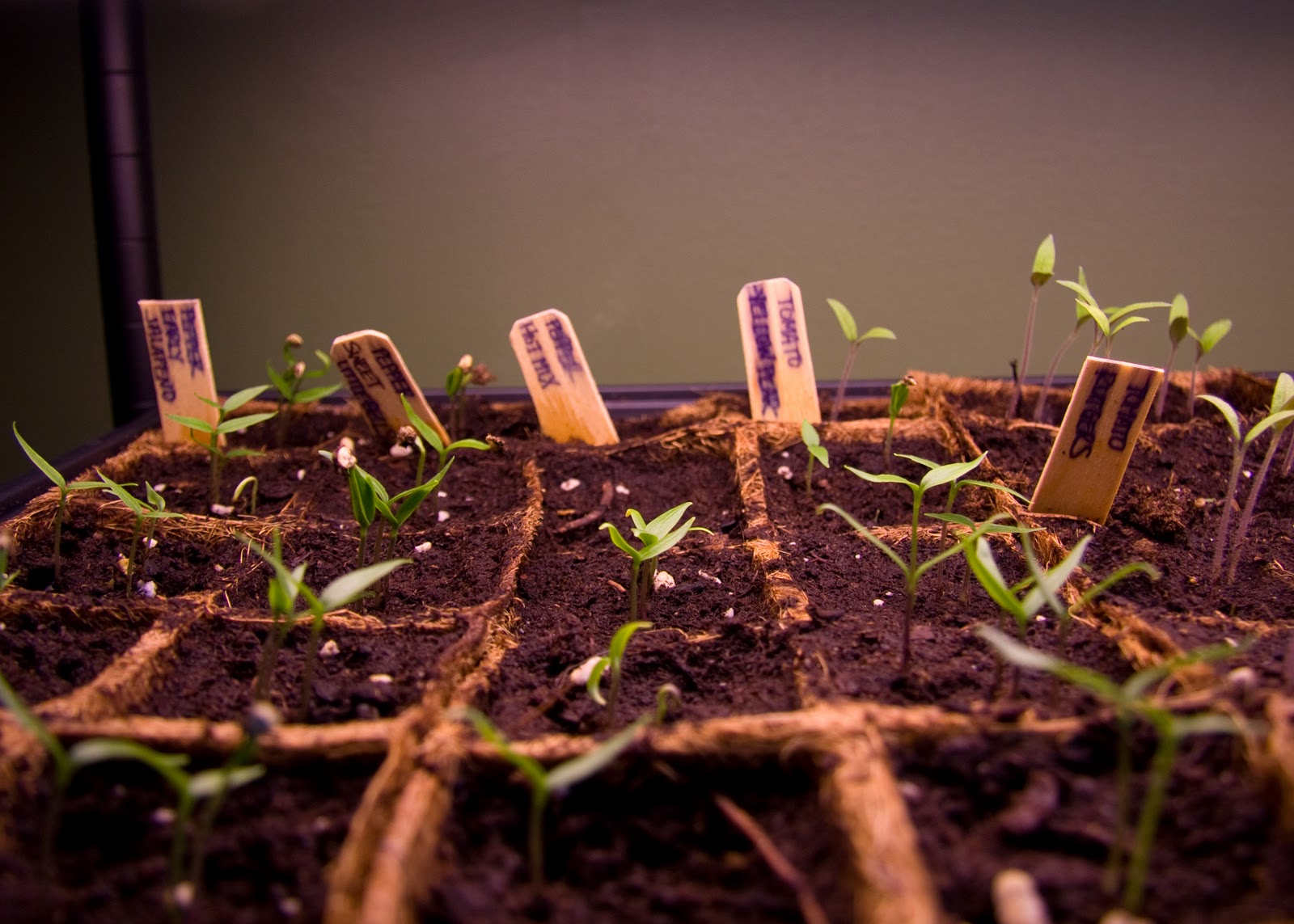
Getting enough light is easily the biggest challenge to a home seed-starter.  While a bright, south-facing window CAN do the trick, I've never had abundant success at growing healthy plants without a bit of supplemental light.  If you're growing a few pots or a single tray, consider a small fluorescent strip light, counter light or lamp.  They're usually easy to find in box stores and are quite inexpensive, and will save the hassle and worry of dealing with leggy, stretched-out plants!  Last year, I built a little 'grow op' in my kitchen that consisted of a metal shelf unit, 2 4' ballasts and 4 T-12 bulbs - this setup cost a total of about $80 (ouch!) but I expect that it will serve me well for several years.  To me, this was a worthwhile investment.  Here's a glimpse of the Mo Farm grow op for this season...

I'll provide instructions for creating your own grow op in a future post... stay tuned if this is of interest to you!

Seeds
Naturally, the last essential ingredients are the seeds themselves.  If you're looking for free tomatoes, I'm your source!  If you'd like me to send you some, please just e-mail your address and a small description of your growing area (garden, pots, balcony, etc) to my at mofarmniagara@gmail.com.    

These are the basic, nitty-gritty must-haves.  There are a few accessories that can help to make growing easier, and I'll detail them when we start the growing process.  In my next post, I'll detail the ins and outs of sowing and growing your seeds as I start my tomatoes.  Are you still hesitant?  C'mon... what are you waiting for?  Let's grow together this season!  I'll coach you every step of the way!

'Round the Bend


It's March, and frankly, not a moment too soon.  I've got a serious case of the winter blahs, and the shot of sunshine and hope that I received today is barely taking the edge off.  With a lingering chest cold and the exhaustion of tackling an ever-present to-do list that comes with a new house, I'm fighting the urge to crawl into bed and stay there until May.

What gets us through these months of freezing temperatures and bleak, gray landscape?  Well, for me, it's the promise of better days full of warm sun, sweet blooms buzzing with the sound of bees and the smell of wet soil and grass.  The dreams of a fresh start and the hope of summer keep me going when I can barely remember what a watermelon tastes like.  Last night, I began to work on this dream of a new season... I started my seeds.  Eggplants, hot peppers, broccoli, brussels sprouts, onions and leeks are officially in my future.

The future of Mo Farm will begin to take shape in the next several weeks as I survey my lot and plan my beds.  More seeds will be sown, the last straggling seed orders will be placed.  I'll find asparagus crowns (I hope) and seed potatoes to plant.  I'll draw and scribble in my notebook.

Spring, my friends, will come.  And I can hardly wait. 

Time to Get SEEDY!

My seeds getting packaged and labeled for the Seedy Saturday exchange table.

That's right - it's the moment I've been anticipating since I picked my last tomato in October... Seedy Saturday is tomorrow!  For me, the growing season begins this weekend as hundreds of folks will gather at Ball's Falls in Vineland to exchange and buy open-pollinated seeds.  Last year, I attended 'Seedy Saturday on a Sunday' in Toronto, and I walked away with a ridiculous amount of seeds, but also with loads of great information and a hefty helping of growing inspiration.  While the draw of the event is the seeds themselves, there are far greater benefits to being a part of the crowd.   

LT&W members pack seeds for the exchange.
If you've never been to a Seedy Saturday event, make this the year that you give it a try!  Events are held all over the country, led by passionate individuals whose hard work and drive make it all possible.  Here, the driving force is Linda Crago of Tree & Twig Heirloom Vegetable Farm in Wellandport.  Linda has worked tirelessly to organize and promote the event, and she'll be there along with the 'Lettuce Turnip & Wine' garden club members helping to run the show.  I recently joined this little group, and I'm excited to help with the event and to invite others to join us this season... but more on that later.

Back to the seeds!  So, what the hell is a Seedy Saturday, and why is it important?  Well, the fact is that many, many, many of the fruit and vegetable varieties that used to exist and thrive have disappeared.  As the modern food machine churns forward and more and more people rely solely on grocery stores for sustenance, the types of produce grown are whittled down to a mere fraction of what used to be available.  Back when folks used to grow their own food, concerns of shipping ease and shelf life didn't factor into the decision-making process for selecting what to grow.  Crops were chosen for their hardiness, adaptation to native conditions and of course, their flavour.  As fewer people grew food and more food needed to be shipped across distances to reach the masses, the standards shifted... varieties are selected for uniformity and for their ability to withstand days and weeks on trucks, leading to the elimination and even extinction of thousands of old varieties.  Many are already lost forever.  Seedy Saturday is essentially the antidote for this.  

Heirloom and open-pollinated varieties of seed are sold and more importantly, exchanged among people who value keeping the delicious, nutritious and unique varieties alive.  An 'open-pollinated' plant is one that will reproduce freely with seeds that will replicate the parent plant.  This means that when you plant an Heirloom or open-pollinated variety, you can save the seeds that it produces and plant them again and again, or as suggested by events like Seedy Saturday, share them.

In our relatively plush society, this idea may seem like a fluffy novelty.  I disagree.  I truly believe that we will witness a collapse of our food system within my lifetime.  Before you start to think me a nut, just bear with me for a moment...  our current system is unsustainable in that it relies almost completely on oil to ship food all over the world.  With resources dwindling and more frequent upsets in the price and availability of foreign oil, it's only a matter of time before the whole thing falls apart.  It's already evident, as food prices around the world begin to skyrocket in response to rising oil prices and natural disasters.  Hey, I'm not trying to fear-monger or preach, but rather explain part of what motivates me to continually attempt to become more self-sufficient.

Whether you're as hung up on growing food as I am, or you're simply interested in the fantastic feeling of pulling fresh, homegrown goods from your own backyard, Seedy Saturday is the perfect way to start your growing season.  Seed vendors, guest speakers and an inspirational buzz will surely get your green thumb itching!  I spent much of last week packaging 117 envelopes of seed that I'll contribute to the exchange table, and I hope to pick up my seed stock for this growing season there as well. I also painstakingly labeled each envelope with the MO FARM blog address, in the hopes that those who pick up the seeds will stop by to say hello and share some of their growing experiences this season.  Seeds are for sharing, and I hope to meet many new faces at the event.  So...will you be there?


All packed up and ready to share!


New, New, New!

Teeny lettuce seedlings from last spring, brimming with promise.

A new year, a new house and a new vision... 2011 is shaping up to be full of excitement and promise!  My husband and I will be moving into our first home at the end of the month, and my head is spinning with the possibilities that this change will bring.  The new lot is a gigantic 50' wide x 206' deep and already boasts loads of perennials, some mature grape vines and a few fruit trees.

As I drool over seed listings and chicken coop designs, I recognize that my biggest challenge this season is going to be pacing myself.  This is tough!  With this sudden availability of excessive space, I'm catching myself mentally planning a whirlwind of construction in the spring... rototilling vast expanses of new garden beds, a water catchment system with irrigation, a chicken coop and fenced run, a doggie area... I have to stop!  It's in my nature to want instant gratification, and keeping my expectations at a reasonable level will be crucial this season, both for my own sanity and for the household budget.

With this in mind, it's time to start making a plan.  An attainable plan.  Our 'move in' date is January 28th, and my first priority (after unpacking) will be to place my first seed order with Linda at Tree & Twig and then start my slow-growing eggplant and peppers.  Then I'll be able to start surveying the lot and planning for new bed construction.  It's an exciting time, and I can't wait to start sharing the creation of Mo Farm with you!

Stay tuned - it's going to get dirty this year, kids!

On that note, I'd like to thank everyone who stopped by the blog in 2010 to read or comment.  This year will bring a host of new challenges and learning experiences, and I hope to grow the Mo Farm community and provide inspiration to all who visit and to learn from one another.  Thanks so much for your help in making this happen!

Mo Farm is MOVIN!


For a change, I have an excuse for neglecting the Mo Farm blog for an extended period of time.  My husband and I have bought a house, and the future of Mo Farm is looking BRIGHT!  I can now begin scheming for the new layout and crops of 2011, and I'll be posting updates on the construction of a chicken coop this spring!

Stay tuned!