Showing posts with label vegetables. Show all posts
I Love Books Like 'Carrots Love Tomatoes'
| The legendary gardening classic has maintained its' popularity for a reason. |
This past winter, I spent a significant amount of time reading. And planning. And reading. And scheming. And reading and dreaming and sketching and reading and gettingsoveryantsy!! In anticipation of my first 'big girl garden' with a new home and new lot in sight, I wanted to make good decisions that were well-informed, and plan my gardens with the best organic practices possible. While my friends will argue this, the fact is that I am NOT an "expert" when it comes to gardening. Frankly, I kinda loathe the term. I know plants, and I love plants, but what drew me to horticulture as a career path in the first place is that it's built for lifelong learning. I've been gardening for almost 15 years, working in the industry for 12, and I learn new things every single day. I hope I'm never an expert.
Something I'm fairly new in discovering is the concept of companion planting. This is certainly not because it's new... it's a practice that's been used by growers for at least a thousand years (according to wikipedia, anyway) that gained renewed popularity in the 70s as the organic movement began gaining serious momentum. It's a concept formed by the principle that some plants are mutually beneficial, while others are incompatible.
Sometimes the relationship works because of physical characteristics of the plants, like the Native Americans 'Three Sisters' - corn providing structure for beans to climb upon, the beans fix nitrogen into the soil for the heavy-feeding corn, and they're grown with squash at the base, which deters animals from eating the corn or knocking it over as well as shading the roots. Sometimes one plant will help to deter common pests of another, as happens with marigolds, which tend to deter aphids and attract predatory insects. Sometimes, plants will actually help to improve the flavour of others, as with mint and basil planted with tomatoes. Incredible, no? This information was, and is, fascinating to me, and quite honestly, a little intimidating. Enter the legendary Louise Riotte!
'Carrots Love Tomatoes' became instrumental in the planning of my veggie beds for this season, as well as all of the surrounding areas. I read the book from front to back, and then kept it at hand throughout the winter and spring as my vision of my gardens began to become clearer. Once I decided to start modestly and work with a four-small-bed system this season, sketching became easier. I worked through the spaces, mindful of companion plants and 'uh oh' combinations, and ended up with a pretty little schematic. Will I stick to it religiously? Not a chance! But it's a PLAN, and something to go by.
| Little beds with BIG plans. |
It's really hard to reign in big dreams. If I had an unlimited budget, and no full-time job, there would be no lawn left and a bounty beyond anything I could imagine. But hey... there's nothing wrong with humble beginnings, you've just got to give it a go, have some patience and let things happen. Happy planting this weekend, friends!
And the offer still stands - if you'd like to head out to Linda's Tomato Days sale at Tree & Twig this Sunday, you can ride with me!
Nothing Is Perfect
I came to an important realization last week. This was that if I continued to wait until the conditions improved, and the sun shone brightly, and the night temperatures stayed consistent, and it stopped raining constantly... I might not begin my gardening season until it was half over. My friends, there is no such thing as a perfect Spring, despite what last year afforded us. Nothing is perfect, and this little fact is one of the things I love most about gardening.
Shit happens, and lots of it. There is a strong possibility that my seedlings will be munched by the bunny I suspect may be living under my deck. The weather might stay crappy all summer and cause diseases, rots, mildews and a poor yield. I might muck everything up myself without outside influence. But the truth of it is that without risks, there are no rewards - it's in the uncertainty of this activity of growing that lies the joy of it.
It was with that simple realization in mind that I planted my first 2 veggie beds of the season on Monday, in the pouring rain, with cold-hardy veggies and seeds. I tied up my old, weather-worn bamboo poles into tripods with twine I found in the shed with chilly, damp fingers covered in clay, and prodded peas into the soil beneath in the hope that they will eventually climb to the top. I set out my seedlings, having coddled them since early March, into the mucky dirt in the hope that they'll thrive and will eventually form heads of broccoli and stalks of brussels sprouts. I drew lines into the earth and dropped tiny beet, radish and carrot seeds into the spaces available in the hope that they won't be washed away before they have a chance to germinate. I constructed a crude little cold frame out of u-shaped bamboo canes and an old plastic drop sheet in the hope that it just might help one bed germinate faster than the other.
It was cold.
It was muddy.
It was messy.
I was happy in every moment of it.
And I am hopeful.
Diggin' In
| New beds were dug last weekend - good thing! |
Rain, rain, go away... and take this April snow with you too! It's a good thing that last weekend was so productive, because this weekend was a disaster! I started creating brand new veggie beds while the sun was shining last week, and was planning to set out all of the broccoli, brussels sprouts, leeks and onions today. Add to that sowing of some beets, lettuces, radishes and some early carrots and it was promising to be a nice, busy weekend. Hmph - best laid plans, right?
Ah well. While I'm waiting for the weather to cooperate, here's a look at how my veggie beds are shaping up and how I went about creating them...
| The season begins with planning & measuring. |
| My existing soil is lovely, rich and free of toxins or heavy metals. |
| The sod is turned over with a spade and I worked it in by hand, filling in large air pockets. |
| The hand-worked soil looked great! |
| Organic matter like composed manure further improves the soil. |
| The finished bed, ready for planting! |
| One down, three to go. Lola Mo knows it's not as easy as it looks. |
So, if it ever stops snowing, the next step is seeding and planting beds 1 & 2 with brassicas, onions, lettuces, and root veggies, to start. Are you in a more fortunate climate than I? What have you planted so far?
In the near future, I'll share my planning process with you, and discuss the benefit of my 4-bed system. Until then, happy growing!
Let's Grow Together!
![]() |
| FREE TOMATOES! It's almost time to start tomatoes from seed. Will you join me this season? |
Well... whaddaya say?
Traditionally, March 15th (or thereabouts) is 'tomato time' in southern Ontario. It's the date that tomato seeds are started to give them just the right amount of time to grow before setting outdoors at last frost in May. I challenge you to join me this season! I'm giving all of you a week of notice - next weekend, I'm sowing my tomatoes and I'd like you to join me.
This week, I'll run through the must-have equipment and basic set-up directions for starting your very own tomatoes from seed. Then, next Sunday, we can all sow together. Sound like fun? You can follow along all summer as we grow our babies from teeny plantlets to giant, fruit-producing goliaths. I'll share my tips and tricks, and help you along every step of the way.
Hesitant? Ok, I'll even sweeten the pot... if you don't have any tomato seeds to start, leave me a comment and I'll mail some to you for free.
There you go, friends - no excuses. Let's make sweet summer magic together!
'Round the Bend
It's March, and frankly, not a moment too soon. I've got a serious case of the winter blahs, and the shot of sunshine and hope that I received today is barely taking the edge off. With a lingering chest cold and the exhaustion of tackling an ever-present to-do list that comes with a new house, I'm fighting the urge to crawl into bed and stay there until May.
What gets us through these months of freezing temperatures and bleak, gray landscape? Well, for me, it's the promise of better days full of warm sun, sweet blooms buzzing with the sound of bees and the smell of wet soil and grass. The dreams of a fresh start and the hope of summer keep me going when I can barely remember what a watermelon tastes like. Last night, I began to work on this dream of a new season... I started my seeds. Eggplants, hot peppers, broccoli, brussels sprouts, onions and leeks are officially in my future.
The future of Mo Farm will begin to take shape in the next several weeks as I survey my lot and plan my beds. More seeds will be sown, the last straggling seed orders will be placed. I'll find asparagus crowns (I hope) and seed potatoes to plant. I'll draw and scribble in my notebook.
Spring, my friends, will come. And I can hardly wait.
Niagara's Seedy Saturday in Photos
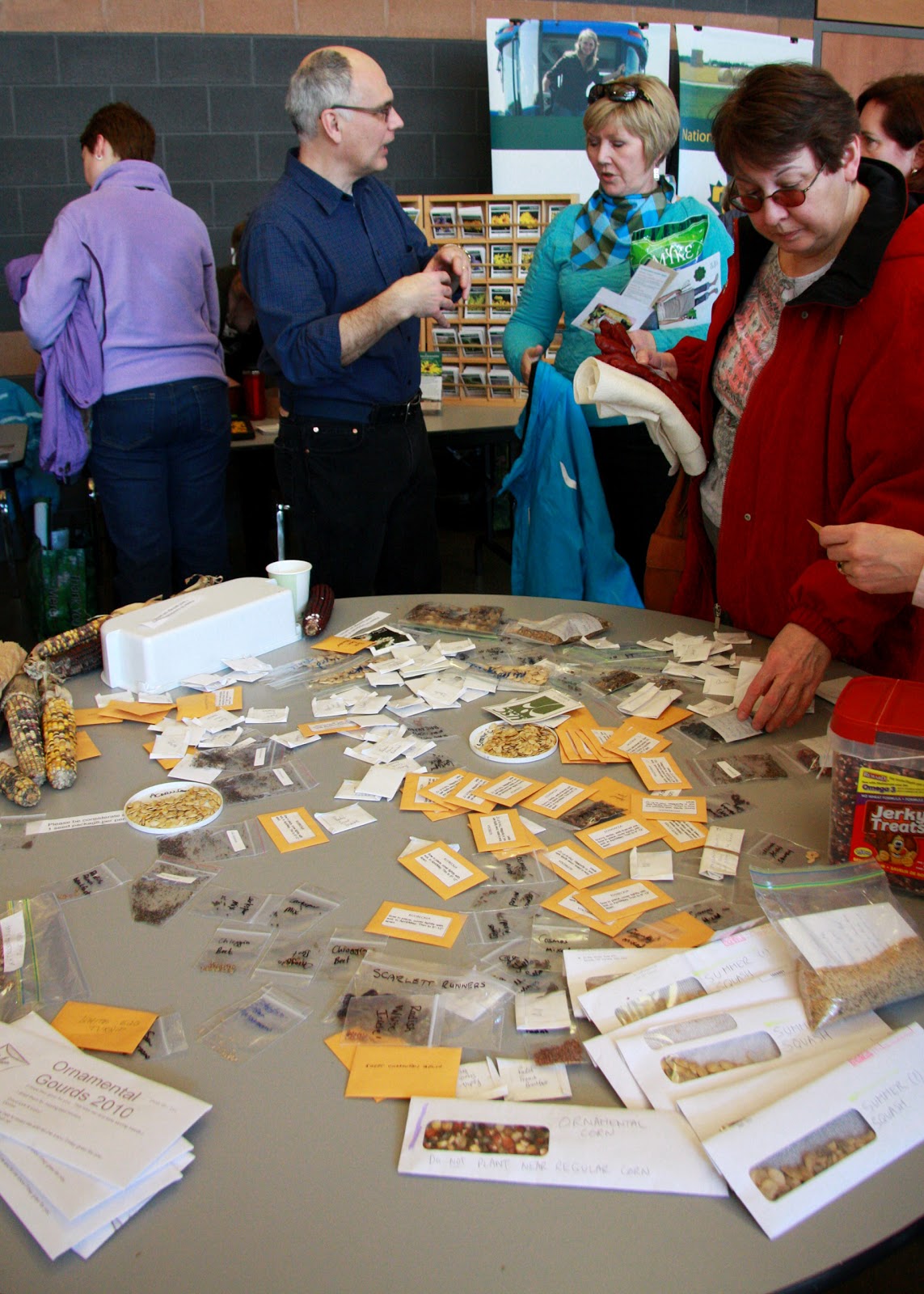
Just in case you couldn't make it out, here's a look at what was happening at Ball's Falls last Saturday !
You can read Linda's blog post about the event from her perspective, and I encourage you to visit some of the links listed above. The vendors and contributors to Niagara's Seedy Saturday were truly exceptional, and I already look forward to a bigger and better event in 2012. Hope you'll be there too!
| The seed exchange table flowed full all day and attracted much attention. |
![]() | ||
| The Lettuce, Turnip and Wine group helped to keep things running smoothly. |
| Tiffany from Eating Niagara tells people about her 'Garden of Eating' fruit tree program. |
| Seeds aplenty at The Cottage Gardener display. |
| More than just seeds for sale! |
| Informative speakers packed the house. |
| Passionate vendors like Mary shared advice and made suggestions to many. |
| Simply spectacular soup and stew was served by local foodies, peapod cuisine. |
| Attendees learned about MYKE, a beneficial mycorrhyzae. |
| Seedy legends Urban Harvest brought the goods! |
| Naturally, Linda at Tree & Twig offered a fantastic array of open-pollinated seeds. |
Do you CSA?
| Photo from plan b organic farms - a CSA in Flamborough, ON. |
Winter stinks.
There are no ifs, ands or buts about it. It's cold, my skin is terrible, the carpet makes my hair crackly with static, and there is nary a piece of homegrown produce to be found. If 'eating local' is of interest to you, the snow-covered months can certainly be a challenge... the garden is frozen, the farmer's markets are closed, the roadside stands are barren and icy, and the supermarket is chalk-full of tasteless orbs flown from Peru, Spain and Ecuador. What's a locavore to do?
Enter your friendly neighbourhood CSA farmer! What is a CSA? Good question! CSA stands for 'Community Supported Agriculture' and it's getting more popular every season. While each CSA program can differ, the basic premise is generally the same and is pretty simple - members of the community buy shares of the farmers' crop in advance of the season. This gives the grower some funds to use to start the crop, as well as a bit of assurance that the foods that are grown will be sold. When the harvest starts rolling in, shareholders start to reap the benefits! Weekly (or bi-weekly) baskets of farm-fresh produce are delivered to drop-off points and are collected by shareholders. It's truly win-win.
So why go to the trouble of paying for your groceries in advance? For me, it's first and foremost about supporting local farmers and knowing where, when and how my food was produced. If I can't grow it myself, I'd certainly prefer to be able to shake the hand of the person who did. If this isn't a major priority for you, a CSA still offers major benefits. Farm-fresh produce is more nutritious and fresh than anything you'll find in a grocery store, guaranteed. It also tastes better! Further, getting a mixed basket of seasonal fruits and vegetables is a great way to introduce your family to new varieties and to truly embed in your children the link between farm and table. Many CSA farms also operate farm stands, so in the season, you can choose to hop in the car and head out to the farm... talk about a kick-ass day trip for the kiddies!
While the winter pickings are a little slimmer, many CSA farms also offer winter season shares. Some provide eggs and preserves in their shares as well as stored root crops and fresh greens, and a few even offer meat. Others subsidize their own home-produced items with carefully selected imports from producers who embody similar growing philosophies. Whether 100% local or partially imported, investing in shares helps to support the important work that our local farmers do all year round. Despite what the food marketers would have you think, local growers don't disappear when the snow flies!
Building connections with eachother and with our food is something our society is seriously lacking, and we have the opportunity as a new generation of parents to change that. The options are there - we just have to use them!
To find out more about Ontario CSAs and to find a farm in your area, you can click here.
I'm a Fan.
| Gayla's most recent book - 'Grow Great Grub - Organic Food from Small Spaces' is a must-have. |
Gayla is a Toronto author, blogger, and small-space/guerrilla gardening champion. I don't mind telling you that she's one of my heroes. Her website, You Grow Girl is a wealth of information and inspiration for newbies and seasoned gardeners alike, and includes her awesome blog as well as one of the best gardening forums on the internet. I first discovered the site in 2005, when I was given Gayla's first book as a gift, entitled You Grow Girl: The Groundbreaking Guide to Gardening .
| My introduction to Gayla's writing opened new doors. |
I devoured 'You Grow Girl', reading it cover to cover at least a dozen times in the first month it fell into my hands. Shortly after, I found myself in the position to put the book into practice when I moved to an apartment in the States where my only gardening space was a partially shaded balcony. If not for the book, I'd likely have determined that growing anything in this teeny situation was impossible... but that summer I enjoyed herbs, strawberries, peppers and loads of flowers thanks to Gayla's sound advice and creative small-space solutions. I didn't know it at the time, but Mo Farm was growing in my heart and mind from the moment I picked the first strawberry that very summer.
Years later, with an actual garden to play in and much more experience under my belt, I was thrilled to hear that a new book was on the horizon for Gayla, and I rushed to pre-order it. When Grow Great Grub: Organic Food from Small Spaces landed in my mailbox, it was like 'You Grow Girl' all over again. I read it. And re-read it. And re-re-read it. I filled it with sticky notes and scribbles, compiling lists of varieties that I wanted to try, projects to undertake, and tips I needed to share. I've bought both of Gayla's books for countless friends, and they're among the most deeply cherished things that I own. I know from her blog that a new book is on its' way, and trust me when I say I'll be first in line to get it.
Stuck for a last-minute gift? You gotta get Gayla!
Baby, It Ain't Over Til It's Over
![]() |
| Keep on sowin'! |
If I was exhibiting my normal patterns, I probably would have called it quits by now. I apparently love quitting, and I do it very well. The nights have been colder, the leaves are beginning to dry and drop, and much of the garden has given me all it has to give. Under ordinary circumstances, I'd have grown tired of my microfarming efforts and thrown in the trowel. But here's the thing - the garden has made me different. In a single summer, I've gained a deeper, personal understanding of growing, and of the incredible rewards that are reaped through patience and persistence. Sure, I was intellectually aware of these things before... I went to school for horticulture, you know! But there is a substantial difference between "knowing" something because you read it or were taught it, and really knowing something because you experienced it yourself. There is truly no substitute for first-hand knowledge.
For me, the approach of Fall always leads to a period of nostalgia. It's a time of conclusions and of new beginnings. I've been reflecting on the season, and I'd like to share a few of the things that I learned. I mean really learned, this summer.
1. Keep on sowing. All the time. Whether you want to or not.
![]() | |
| Mid-season seeds for late-season lettuce. |
I had a few major gaps in my garden's production because I neglected to follow this rule. I was so thrilled with my carrots and beets as I pulled them from the ground, but as my supply dwindled, I realized with dismay that I would have been able to enjoy them ALL season if I had simply sown more in succession. The varieties I grew take about 65-75 days to reach harvest size, and I really dropped the ball on that one. Lesson learned, however - I sowed fresh lettuce in August that is now almost ready to cut for baby greens.
2. Expect problems. Embrace the chance to learn.
![]() | ||||
| What the hell?!? Tomato trouble led to research and change. |
![]() |
| Cracking fruit makes Kris cry. |
In late July, my tomatoes were just starting to ripen and I was elated. Then they got all bitchy on me. Brown spots, curled leaves, dropping flowers, cracking fruit... what the hell?? I hit the forums and cracked open my books, looking for the solution to my problems, which I suspected were fungal. The tricky part is that often garden problems can be caused by multiple factors - weather, water, humidity, diseases, insects, human error... the list is endless. My book told me that the best course of action was to immediately destroy the affected plants, thus reducing the likelihood that the problem would spread to my other tomatoes. Sound advice, yes, but I didn't like it. Instead, I removed all of the spotted foliage, cut off the troublesome branches, and fertilized my sick plant with an organic mix high in phosphorus to try and coax some fresh flowers and fruit. It worked. Was I right and the book wrong? Do I possess healing powers? Not likely. Next time, it may not work out so well, but at least I have some weapons in my arsenal that I devised from first-hand experience.
3. You will always make mistakes. It's ok. Write them down!
My peas needed more sun. My cucumbers did terribly because they needed more space. I don't really like dry beans, so I probably shouldn't grow them. I need more herbs, peppers and greens and way fewer tomatoes. Eggplant seedlings need to be started in January, because they are sssllllooooowwwww. I'm not ashamed that many of my backyard endeavors didn't work out this year, but I'm determined not to repeat the same mistakes. After all, I need to save room for NEW mistakes!
4. Share the load, share the harvest, and share the joy.
![]() | |
| Farmer A. |
![]() | ||
| Farmer C. |
One of the greatest things about growing food is that it fosters connections. You connect with the earth. You connect with a real food source and a sense of sustainability. You connect with people, both familiar and strange. Sharing the work of Mo Farm has been vital, and sharing the JOY of Mo Farm has been life-changing. I'm so lucky and so grateful to have been able to depend on my sister and my husband for a hand in the dirt.
These are just a few of the things that this garden has taught me this season. I know now that this is a way of life for me. It's not a phase, a fad, or a hobby. Growing food is something that I'll always do.
And baby, it ain't over til it's over.
The sun is still shining, the vines are still full, and I've got work to do. Time to get these hands dirty!
On The Wild Side
My garden has gone feral. In a way it's a relief, but it's an odd realization that all of my planning, preening and care is in many ways completely irrelevant. Throughout the summer, life gets in the way of my good gardening intentions, and I'm left with little choice but to allow my garden to thrive on neglect. (Oh... did you think you were the only one?)
With vacations, a busy work schedule and old-fashioned summer laziness taking up my time, I've been able to let the garden just... be. To my chagrin, it remains lush and productive without my intervention. Who knew? Yes, the tomatoes are out of control. Yes, that IS a bolted, flowering head of lettuce in the middle of the photo. But that's ok.
Here are some additional pictorial updates. Summer madness - it's good stuff!
Carrots, mixed beans and thyme for the dinner table.
A 'Dusty' eggplant. It was a 'cheater' I planted in mid-July when I realized that my 'Little Fingers' were definitely not going to reach fruiting size this season. A good score from the garden center saves the day... there's nothing wrong with a back-up plan! I don't feel guilty!
Another ringer. 'Sweet Cherry Pick' peppers I bought at the same time as the eggplant, just because I couldn't resist. C'mon, look how cute!
'Bright Lights' swiss chard. Indeed!
Remember how I planted some watermelon in the space left by the spent lettuce? It's gone bananas, and I couldn't be happier...
Little 'Malali' watermelon. More where this one came from, too. There WILL be home-grown watermelons this season, and by any account I can think of, this officially makes my summer gardening effort a success.
Anatomy of a Local Dinner
It started with a small inspiration. I was wandering through the garden in the golden hour of the evening, absentmindedly pulling a few weeds, munching a few peas, when I spotted it... the telltale rounded crescent of the top of a Golden Detroit beet, the first of the season, peeking from the surface of the soil. I crouched down and prodded it with my finger, making sure it was loose enough to pull. It was. With a gentle tug, it popped out of the earth, and I literally gasped - it was so pretty! Bright orange and perfectly round, it demanded to be turned into something special. The wheels in my head started turning...
I foraged around the rest of the garden, looking for more ingredients that were ripe or big enough to consider harvesting. I managed a bowl of crisp baby greens, a small handful of carrots, and a giant of a green onion, curved and beautiful.
After a quick consultation with Jamie, I set to work washing and chopping, seasoning, wrapping, heating, and singing, filled with the simple joy of cooking for myself and my husband with fresh, delicious ingredients that promised to nourish our bodies and delight our palates. Here is the result:
Fresh, roasted veggies in olive oil with sea salt, pepper, garlic and a splash of balsamic vinegar.
Local chicken from Fenwood Farms, buttered sugar snap peas and roasted peppers, zucchini and mushrooms from Hildreth Farm Market, and Mo Farm baby greens, beets, green onions and carrots.
Good food = good marriage. The math is simple.
Subscribe to:
Posts (Atom)