Showing posts with label grow food. Show all posts

Spring?

It must be, because my seeds are here!  It's been a loooong winter for my family and I, and I've been miserable at updating the Mo Farm blog.  But it's a new season, and a fresh start, and I cannot WAIT to be back in fresh air, sunshine and soil.

Looking back at last season, I'm already behind! I'll be sowing my first round of seeds this weekend, (a solid week behind last season's schedule) and you can start too!  Check out this post from last year for everything you need to sow & grow from seed!  And stay tuned... because Spring is here!


Bonus Berries

The surprise (and delight!) of my summer has been provided by a plant I didn't know I had.  When I moved into my house in January, the garden was a mystery.  Discovering perennials and shrubs as they emerged from winter's sleep was a horticultural treasure hunt!  So, when this cluster of hollow woody canes popped up beside the fence, I trimmed them and shaped them as I would any other plant.  Imagine my surprise when hundreds of berries began to form in June!  It took a while, but they've ripened into the most delicious blackberries I've ever had.  Bonus!

My Sisters (A Bit Corny)

High as an elephant's eye?
This season marked the first time I've ever tried growing corn.  With a wet, cool and muddy spring, I chose to hold off on planting until well into June, so I wasn't sure how successful I'd be. That said, like most of my gardening endeavours, for me it's more the experience of trying than the success of the harvest that matters most. With that in mind, my husband and I dug a 10' x 10' bed and plunked seeds into the soil.

More turf bites the dust - this yard's for growin!

Within two weeks of planting, corn was looking like corn. Sweet!
 Reading about how other people grow things inspires and empowers me.  This past winter and spring, I was really interested in learning more about companion planting, and I came across many mentions of the 'Three Sisters', a method of growing long used by the native Americans.  Corn, squash and beans grow symbiotically together, so that's what I decided to do. I interplanted corn with my 'Costata Romanesco' zucchini and golden hubbard squash, the theory being that the rough, spiky stems and leaves of the squash plants deter hungry critters like raccoons and squirrels from climbing or knocking over the corn stalks.
My 'Three Sisters' garden begins to take shape in July, as viewed from the deck.
Zucchini growing happily in the shade of the corn.
In the next phase of planting, pole beans are sown amid the corn.  Beans fix nitrogen from the air into the soil, supplying the hungry, rapidly-growing corn with nutrition.  In exchange, the corn provides structure for the beans to climb upon.  It's a pretty good arrangement!


The ornamental qualities of the corn at all stages of growth was a pleasant surprise. She's a looker!
 So, the big question... did it work?  Well, yes and no.  Nothing is perfect, as I'm always reminded by my garden.  The zucchini produced beautifully throughout late July, but then suffered in the heat and humidity, afflicted with terrible powdery mildew and all but halting flowering and fruiting.  The corn is still growing, and has in fact produced cobs.  
The first cobs of corn begin to form in late July - success?
 Success! (I think.) I'm unsure of when to pick them, as they're quite small, and I'm not confident they'll fully ripen.  The beans were planted very late, but are climbing happily and beginning to form flowers.  I think I'll get some before summers' end, which is approaching much more quickly than I'd prefer!  Overall, I'm proud of my Three Sisters experiment, and I'm looking forward to modifying and repeating the process next season.  Homegrown corn may not be in my kitchen as of yet this summer, but thankfully, there's plenty of local gold to enjoy, courtesy of Ontario farmers much more talented than I!
Corny.


Welcome Back, Tomatoes!

The first ripe tomato of my season!

They're finally back!  The very first ripe tomatoes of the season appeared in the gardens last night, opening the door to months of juicy, seedy, delicious goodness.  

A big, beautiful 'Black Krim' deepens in colour on the vine.

Oh how I missed you, my dearest Black Krim... never leave me again!

Of course they will leave, as all seasonal foods must.  So it's up to us to enjoy every little bite, and every slurp, and every beautifully glowing orb on the vine.  We shall can! And we shall freeze! And we shall celebrate!  Which reminds me... 

Tree & Twig Tomato Tour 2010. Wowsa!

Linda of Tree & Twig has announced the date for her annual Tomato Bash at the farm! I had such an amazing time last year, and if you missed it, I know that you regretted not coming when you saw the pictures. Don't make the same mistake this year - come on out to Tree & Twig on September 4th!  If you're in my neck of the woods, you're welcome to ride with me.

Until then, I'll be wrist-deep in tomato glory...  Yippee! 

A 'San Marzano' - won't be long now!
'Black Plum' ready for eating. It was so sweet!

Let's Grow Together: A Beet-Down!

Go babies, grow!

One of the many mistakes I made last season was failing to continually seed throughout the season.  It's so easy to be gung-ho in the spring, but it's also easy to forget to keep things rolling throughout the summer by simply plunking more seeds into the empty spaces left by early producers.  Thankfully, it's a lesson I learned, and this year I'm determined to keep my garden producing all season long... and I'm not the only one.

Linda Crago of Tree & Twig has laid down a challenge to gardeners... a 'beet-down', if you will.  The Late Beet Planting Challenge extends from coast to coast, with participants agreeing to plant and harvest a crops of Detroit Dark Red beets at (approximately) the same time.  It was a challenge that I couldn't resist, and though I was late to the game (I sowed my seeds about 48 hours AFTER everyone else because I'm a terrible procrastinator) I'm pleased to see my new beet crop poking up through the soil.  Will my beets outshine their competition? Will they get munched by mystery pests like my spring drop of Golden Detroits? Only time will tell!

It's too late to join this particular challenge, but it certainly serves as a reminder to keep on sowin'! Right now is the perfect time in Southern Ontario to think about planting fall crops like beets, carrots, parsnips, cabbage and kale, and as long as the sun keeps shining, there is always room for a little more lettuce!  Need some beet seeds? Linda was very gracious in sharing hers, I can certainly pass along the favour! If you'd like some FREE BEET SEEDS in the mail, just drop me an e-mail with your address and I'll send them your way... just promise to tell me how you made out with your late planting challenge!


In Case You've Been Under A Rock...


I feel I would be remiss if I didn't give a big ol' shout out to Julie Bass, the suburban resident of Oak Park, MI who is being charged by her city for the unspeakable crime of growing vegetables in raised garden beds (GASP!) in FRONT of her house. Imagine the horror!

Click on the video for the story, if perchance you've not yet heard it.  I don't think I need to tell you where I stand on the issue... frankly, I'm surprised that the city is maintaining such a strong stance in the face of the outrage they're receiving from people all over North America and as far as Australia. 

Truly noteworthy, however, is Julie herself.  I just spent the morning reading her entire blog, and I have to tell you that I'm utterly charmed.  Julie writes from a real and personal perspective, she answers comments (which at this point, I'm sure is close to impossible) and she conducts herself with incredible poise and dignity.  When crap like this goes viral, which it now has, the central figure suddenly becomes a public personality and is subjected to the opinions and comments of every jackass with an internet connection... it's a scary thing! Julie always takes the high road, and for that as much as her veggie-rights cause, she should be commended.

So, want to help her out?
Write to the city of Oak Park, MI 
Sign the petition 

Cheers to Julie Bass and her front-yard veggies!  

Road Trippin': Bonnaroo 2011

The famous arch at Bonnaroo '11 in Manchester, TN.
Do you ROO?

Every June in Manchester, Tennessee, something wild and wonderful happens.  Tens of thousands of music fans from all across North America descend upon an enormous field in the middle of nowhere for the Bonnaroo Music & Arts Festival - a celebration of music and culture unlike anything else!  My husband and I had made this trip before in 2004, so this year we were packed, prepped and ready to rock with 134,000 of the strangest and most amazing people you've ever seen.

Kris Mo - wristbanded and ready for rock.
The diverse lineup of artists drew us back to Tennessee this year, and we weren't disappointed. More than 100 bands including Arcade Fire, My Morning Jacket, Buffalo Springfield, Florence + the Machine, and yes, even Eminem rocked on multiple stages throughout the 4 days and nights at all hours.  Magic happened, my friends, and it's a vacation I'll never forget.

So what does this have to do with 'urban farming' and why am I writing about it on the blog?  Well, I was surprised and delighted to find that the love of locally-produced, artisan cuisine and enthusiasm for growing food at home was prevalent at Bonnaroo!  Gourmet food trucks came from across the country to showcase their signature dishes to thousands of fans, and we enjoyed incredible meals like vegan curry from Gastropod (Miami), and a quirky and delicious snack you have to taste to believe called a 'Petro'.        

'The Academy' run by the festival offered free workshops all weekend on topics like sustainable gardening practices, composting, and growing food in containers, even showcasing examples of different garden styles and a mud-and-straw house.  Awesome!  Watching people mingle around the gardens, reading tags and touching the tomato leaves was really cool to see, and my heart nearly burst as I watched passers-by empty their (precious!) water from their reusable bottles onto the dry soil for the plants. It was in the mid-40's all week, and the heat took a toll on everyone, including the veggies!

Here's a glimpse at the gardens of Bonnaroo 2011:

Teaching gardens at 'the Academy' - Bonnaroo 2011.

Demonstrating growing food in small spaces with repurposed containers. Sweet!

The Victory Garden surrounded a clay-covered straw bale house - a cool respite from the Tennessee heat!
In one more happy discovery, I found Oxfam at Bonnaroo too! In my last blog post, I mentioned Oxfam's GROW campaign, and they were out in full force at the festival, raising awareness of the campaign and signing up green-minded folks in droves.  Hurray!
 

I Love Books Like 'Carrots Love Tomatoes'

The legendary gardening classic has maintained its' popularity for a reason.
Loooong weekend! This is it - it's time for all of the planning to come to fruition as we bust out of the house and into the soil with gusto. Planting mindfully is important, though, as tough as it can be.

This past winter, I spent a significant amount of time reading. And planning. And reading. And scheming. And reading and dreaming and sketching and reading and gettingsoveryantsy!!  In anticipation of my first 'big girl garden' with a new home and new lot in sight, I wanted to make good decisions that were well-informed, and plan my gardens with the best organic practices possible.  While my friends will argue this, the fact is that I am NOT an "expert" when it comes to gardening.  Frankly, I kinda loathe the term.  I know plants, and I love plants, but what drew me to horticulture as a career path in the first place is that it's built for lifelong learning.  I've been gardening for almost 15 years, working in the industry for 12, and I learn new things every single day.  I hope I'm never an expert.

Something I'm fairly new in discovering is the concept of companion planting.  This is certainly not because it's new... it's a practice that's been used by growers for at least a thousand years (according to wikipedia, anyway) that gained renewed popularity in the 70s as the organic movement began gaining serious momentum.  It's a concept formed by the principle that some plants are mutually beneficial, while others are incompatible.  

Sometimes the relationship works because of physical characteristics of the plants, like the Native Americans 'Three Sisters' - corn providing structure for beans to climb upon, the beans fix nitrogen into the soil for the heavy-feeding corn, and they're grown with squash at the base, which deters animals from eating the corn or knocking it over as well as shading the roots.  Sometimes one plant will help to deter common pests of another, as happens with marigolds, which tend to deter aphids and attract predatory insects.  Sometimes, plants will actually help to improve the flavour of others, as with mint and basil planted with tomatoes.  Incredible, no?  This information was, and is, fascinating to me, and quite honestly, a little intimidating.  Enter the legendary Louise Riotte!

'Carrots Love Tomatoes' became instrumental in the planning of my veggie beds for this season, as well as all of the surrounding areas.  I read the book from front to back, and then kept it at hand throughout the winter and spring as my vision of my gardens began to become clearer.  Once I decided to start modestly and work with a four-small-bed system this season, sketching became easier.  I worked through the spaces, mindful of companion plants and 'uh oh' combinations, and ended up with a pretty little schematic.  Will I stick to it religiously? Not a chance!  But it's a PLAN, and something to go by.

Little beds with BIG plans.
By using smaller beds this summer, I'll plant my gardens more intensively, paying close attention to the soil.  This is always paramount in organic gardening... the soil is everything and by starting with smaller spaces in my first season at this house, I'm ensuring that the soil quality will meet my needs.  It will also make it much easier to plan next year's gardens with crop rotation in mind.

It's really hard to reign in big dreams.  If I had an unlimited budget, and no full-time job, there would be no lawn left and a bounty beyond anything I could imagine.  But hey... there's nothing wrong with humble beginnings, you've just got to give it a go, have some patience and let things happen.  Happy planting this weekend, friends!  

And the offer still stands - if you'd like to head out to Linda's Tomato Days sale at Tree & Twig this Sunday, you can ride with me! 

Tomato Days are Coming!

I'm so excited for Tomato Days at Tree & Twig!  I'll be heading out to see Linda on Sunday, May 22nd - anyone who would like to come along with me is welcome to join in the fun. 

Progress

The first blossoms open in my backyard.

So much has been happening at Mo Farm - there's hardly time to post about it!  A quick update...


Peas are emerging.


So are beets, both Golden Detroit & Chioggia.
Hopeful little Golden Detroit beets.
Mammoth Melting Sugar peas begin to emerge. I can taste them already!

The fruit trees are blooming wildly - it's like a circus and I'm in love!


Blossoms & blue sky.
I expanded the existing perennial border on the left side of the yard and added 2 yards of black loam (with the help of my small and mighty sis!)  It will now become the 'fruit forest' where I've planted rhubarb and a blueberry already, and will soon add additional blueberry varieties, strawberries, plum and apricot trees, another cherry, and an assortment of perennial faves.
My newly-acquired 'Pink Lemonade' blueberry.

The fruit trees buzz with life. It's awesome!

On the not-so-great side,  the broccoli and brussels sprouts are pretty lame.  They're doing fine, but haven't put on any growth at all since being planted... we'll see what happens!

Finally, the downer-of-the-month: my fence blew down.  Almost all of it.  It was a wild storm that impacted hundreds of homes in the area, and frankly, I suppose we're lucky.  Some folks close by had giant trees crash through their homes or onto their cars... that said, way too much time and money will need to be spent in the next week in order to repair the damage.  Ahhh, glorious homeownership...

Nothing Is Perfect


I came to an important realization last week.  This was that if I continued to wait until the conditions improved, and the sun shone brightly, and the night temperatures stayed consistent, and it stopped raining constantly... I might not begin my gardening season until it was half over.  My friends, there is no such thing as a perfect Spring, despite what last year afforded us.  Nothing is perfect, and this little fact is one of the things I love most about gardening.

Shit happens, and lots of it.  There is a strong possibility that my seedlings will be munched by the bunny I suspect may be living under my deck.  The weather might stay crappy all summer and cause diseases, rots, mildews and a poor yield.  I might muck everything up myself without outside influence.  But the truth of it is that without risks, there are no rewards - it's in the uncertainty of this activity of growing that lies the joy of it.  

It was with that simple realization in mind that I planted my first 2 veggie beds of the season on Monday, in the pouring rain, with cold-hardy veggies and seeds.  I tied up my old, weather-worn bamboo poles into tripods with twine I found in the shed with chilly, damp fingers covered in clay, and prodded peas into the soil beneath in the hope that they will eventually climb to the top.  I set out my seedlings, having coddled them since early March, into the mucky dirt in the hope that they'll thrive and will eventually form heads of broccoli and stalks of brussels sprouts.  I drew lines into the earth and dropped tiny beet, radish and carrot seeds into the spaces available in the hope that they won't be washed away before they have a chance to germinate.  I constructed a crude little cold frame out of u-shaped bamboo canes and an old plastic drop sheet in the hope that it just might help one bed germinate faster than the other. 

It was cold.  

It was muddy.  

It was messy.

I was happy in every moment of it.  
And I am hopeful.


Diggin' In

New beds were dug last weekend - good thing!

Rain, rain, go away... and take this April snow with you too!  It's a good thing that last weekend was so productive, because this weekend was a disaster!  I started creating brand new veggie beds while the sun was shining last week, and was planning to set out all of the broccoli, brussels sprouts, leeks and onions today.  Add to that sowing of some beets, lettuces, radishes and some early carrots and it was promising to be a nice, busy weekend. Hmph - best laid plans, right?

Ah well.  While I'm waiting for the weather to cooperate, here's a look at how my veggie beds are shaping up and how I went about creating them...

The season begins with planning & measuring.
 Starting new garden beds in a lawn can be intimidating.  You look across a perfect sea of green, and it takes a bit of visualization to consider the possibilities.  There are many ways to start a veggie garden, and my plans changed the moment I stuck my spade into the soil.  I had thought that I'd construct raised beds by removing the sod, building cedar boxes out of 2x6 boards and filling in with loads of compost... BUT, I was thrilled to find that beneath the monoculture of my ordinary lawn laid extraordinary native soil.  

My existing soil is lovely, rich and free of toxins or heavy metals.
Oh, the luck!!  It's a lovely clay loam that's rich in colour and easy to work with a shovel.  My friends, it would be criminal not to take advantage of this! I decided that I'd start with 4 beds, each 4' wide by 10' long, separated by 2' of space between them.  I'd turn under the sod, add some additional organic matter, and count myself a lucky gal. 

The sod is turned over with a spade and I worked it in by hand, filling in large air pockets.
It didn't take long to turn the sod over.  I methodically dug a spade-depth down and tossed the sod under, working back and forth across the width of the bed with Arcade Fire providing the soundtrack... not a bad way to burn a few calories!  After all of the sod was loosely turned, I went back over it by hand and with a small trowel, setting the chunks into place and filling in any large air pockets and breaking up the biggest chunks of clay.  Here's what it looked like after that:
The hand-worked soil looked great! 
 At this point, some may think, 'Why the hell didn't you just use a tiller?!'  Hand-turning soil is tough work, and yes, a tiller would have been much easier.  But I think that the easy way isn't always the best way - we're finding that out every day, aren't we?  A motorized rototiller rips up the soil in minutes, but the process is pretty violent.  I'd have obliterated the helpful earthworms that are in the soil (and I saw LOTS of them - a good sign!) and tilling can cause compaction of the sub-soil, which can inhibit healthy root growth over time.  So, I decided to put in the work, save the gas, and now I have beds that will never need to be tilled and will teem with life.  Not a bad deal.

Organic matter like composed manure further improves the soil.
  With the bed turned and ready to rock, I began adding some extra organic matter to further improve the condition and fertility of the soil.  First, I put down a thin layer of newspapers, which I hope will help to inhibit the re-growth of any of the sod.  I watered the paper well, and then topped it off with beautiful, black, composted sheep manure.  

The finished bed, ready for planting!
Finally, I topped off the whole thing with some loose triple-mix, loaded with more organic matter and bonemeal.  The consistency and texture of the new bed is perfect, with well-worked, loose soil that will allow teeny little roots to grow.

One down, three to go.  Lola Mo knows it's not as easy as it looks.
Three more identical beds will run along the fenceline, and Mo Farm will soon be producing some great food.  Starting small like this will allow me to make adjustments and plan carefully for expansion as I go along.  I would have loved to turn under the entire lawn... but I know that this is a smart start!

So, if it ever stops snowing, the next step is seeding and planting beds 1 & 2 with brassicas, onions, lettuces, and root veggies, to start.  Are you in a more fortunate climate than I?  What have you planted so far?

In the near future, I'll share my planning process with you, and discuss the benefit of my 4-bed system.  Until then, happy growing! 


A Back-Up Plan

Linda at Tree & Twig Heirlooms will host her annual Tomato Days event on the May long weekend this year.
Everyone needs one, whether for a little bit of insurance in case something happens to your seedlings, or in the case that you read the last post and thought... to hell with that!  If you're not into the idea of growing your own veggies and fruits from seed, there is certainly no reason that you can't get into the fun of having a garden this season.
On the May long weekend, Linda at Tree & Twig Heirlooms will host her annual Tomato Days sale, where unthinkable numbers of tomato seedlings will be available to purchase, along with other started veggies.  I won't be able to resist expanding my collection, but for others, the event presents a unique opportunity to get in on the grow-your-own action and to meet others who want to do the same.
Check out Linda's post on her blog about Tomato Days, and mark it on your calendar!

Gear Up! (What You Need to Grow From Seed)

Growing plants from seed is rewarding, fun and not nearly as tough as you think!
Are you ready for an adventure in food production?  Growing your own food at home is awesome - it's healthy, it's fun (mostly) and best of all, it's so rewarding!  With a bit of effort and some basic skill and patience, this can be the summer that you bite into your very own homegrown tomato... and trust me when I tell you that there is nothing else quite so delicious!

So - where to begin?  First off, if you're not down with the whole 'growing from seed' thing, that's ok. You can still play along this season, you just have to sit out the first couple of rounds!  I love growing my plants from seed for a few reasons.  Mostly, it's because something happens to me around seed sales, swaps and catalogue listings... I lose control of myself and end up impulsively collecting varieties for the sheer thrill of it.  That said, growing from seed gives me the satisfaction of having been in control of the growing process from the very beginning, which to me, adds extra pride and bragging rights!  But it also allows me to grow a wider range of varieties, many of which are rare, obscure or hard to find.  If you choose to buy your plants as babies (or 'starts') you can still enjoy all of the rush and joy of growing food at home, without the extra steps of seeding and coddling the little ones.

For those with a bit more cavalier spirit, this week I'll walk you through the steps that you need to take to grow plants successfully from seed.  We'll sow and grow together, and if you're in my climate zone, you can just monkey-see-monkey-do your way through this thing.  Good deal!  

If you're been into any sort of garden center lately, you'll have found that there is no shortage of equipment, accessories and supplies that can help to make seed-starting easier.  With such a wide range of options available, it's easy to find a system that will work for your space and your budget... but it's also easy to get carried away.  There are a few really basic things that you will need to grow from seed, and everything else is optional.  Here's what I use at home:

Trays, Pots or Containers
Naturally, you're going to need something to physically grow your plants in.  I prefer a biodegradable tray system (similar to the one pictured left) that consists of a plastic undertray, clear plastic dome lid and coir cells that can be filled with whatever growing medium I choose.  This is a personal preference, and one that I've found works well for me.  You can use a traditional cell-pack tray, small pots, toilet rolls, yogurt containers.... really anything will do as long as it's not too deep and will hold soil, but allow water to drain freely.  The item shown, which has 72 cells, runs for about $9-10 retail, and you can find other sizes and styles from $4 and up.

Growing Medium
You don't grow plants in dirt!  I start my seeds in a 'propagation' mix that's ready-to-use right out of the bag.  It's light and airy, and is specifically mixed to provide the right amount of water retention and aeration that will allow seeds to thrive.  Some people choose to make their own mix out of peat, coir, sand... there are lots of options.  I recommend starting simple with a mix that is made for growing seeds or cuttings for the best results.  Once you gain confidence and experience, you can start customizing your system to work best for you!  (Please note - While I've chosen an image from Miracle Gro and that is what I bought this season, I'm not endorsing any specific brand here... just providing what I feel is a good visual example.) 

Light
Getting enough light is easily the biggest challenge to a home seed-starter.  While a bright, south-facing window CAN do the trick, I've never had abundant success at growing healthy plants without a bit of supplemental light.  If you're growing a few pots or a single tray, consider a small fluorescent strip light, counter light or lamp.  They're usually easy to find in box stores and are quite inexpensive, and will save the hassle and worry of dealing with leggy, stretched-out plants!  Last year, I built a little 'grow op' in my kitchen that consisted of a metal shelf unit, 2 4' ballasts and 4 T-12 bulbs - this setup cost a total of about $80 (ouch!) but I expect that it will serve me well for several years.  To me, this was a worthwhile investment.  Here's a glimpse of the Mo Farm grow op for this season...

I'll provide instructions for creating your own grow op in a future post... stay tuned if this is of interest to you!

Seeds
Naturally, the last essential ingredients are the seeds themselves.  If you're looking for free tomatoes, I'm your source!  If you'd like me to send you some, please just e-mail your address and a small description of your growing area (garden, pots, balcony, etc) to my at mofarmniagara@gmail.com.    

These are the basic, nitty-gritty must-haves.  There are a few accessories that can help to make growing easier, and I'll detail them when we start the growing process.  In my next post, I'll detail the ins and outs of sowing and growing your seeds as I start my tomatoes.  Are you still hesitant?  C'mon... what are you waiting for?  Let's grow together this season!  I'll coach you every step of the way!

Let's Grow Together!

FREE TOMATOES!  It's almost time to start tomatoes from seed.  Will you join me this season?
 
Well... whaddaya say?

Traditionally, March 15th (or thereabouts) is 'tomato time' in southern Ontario.  It's the date that tomato seeds are started to give them just the right amount of time to grow before setting outdoors at last frost in May.  I challenge you to join me this season!  I'm giving all of you a week of notice - next weekend, I'm sowing my tomatoes and I'd like you to join me.

This week, I'll run through the must-have equipment and basic set-up directions for starting your very own tomatoes from seed.  Then, next Sunday, we can all sow together.  Sound like fun?  You can follow along all summer as we grow our babies from teeny plantlets to giant, fruit-producing goliaths.  I'll share my tips and tricks, and help you along every step of the way.

Hesitant?  Ok, I'll even sweeten the pot... if you don't have any tomato seeds to start, leave me a comment and I'll mail some to you for free.

There you go, friends - no excuses.  Let's make sweet summer magic together!  

'Round the Bend


It's March, and frankly, not a moment too soon.  I've got a serious case of the winter blahs, and the shot of sunshine and hope that I received today is barely taking the edge off.  With a lingering chest cold and the exhaustion of tackling an ever-present to-do list that comes with a new house, I'm fighting the urge to crawl into bed and stay there until May.

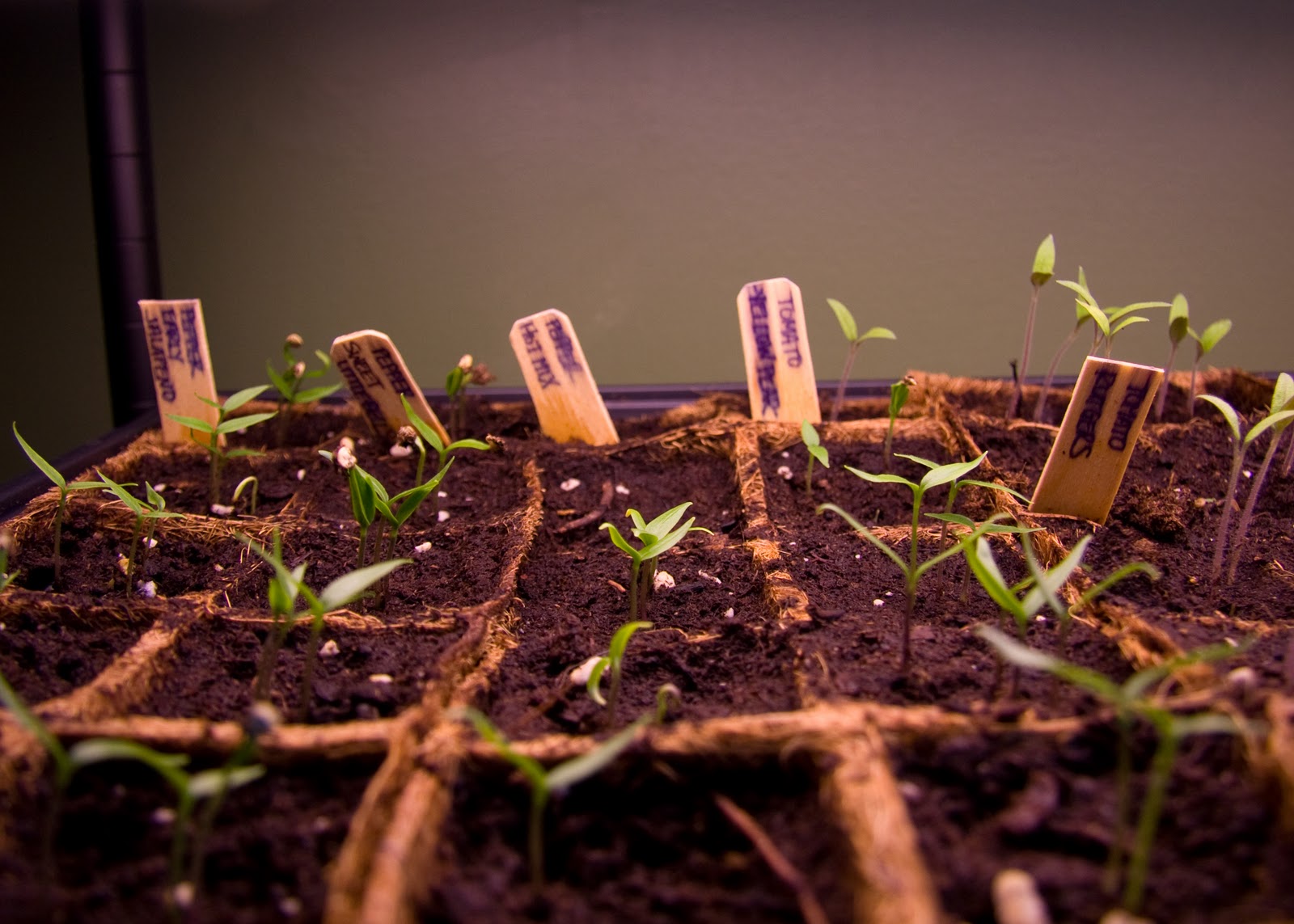
What gets us through these months of freezing temperatures and bleak, gray landscape?  Well, for me, it's the promise of better days full of warm sun, sweet blooms buzzing with the sound of bees and the smell of wet soil and grass.  The dreams of a fresh start and the hope of summer keep me going when I can barely remember what a watermelon tastes like.  Last night, I began to work on this dream of a new season... I started my seeds.  Eggplants, hot peppers, broccoli, brussels sprouts, onions and leeks are officially in my future.

The future of Mo Farm will begin to take shape in the next several weeks as I survey my lot and plan my beds.  More seeds will be sown, the last straggling seed orders will be placed.  I'll find asparagus crowns (I hope) and seed potatoes to plant.  I'll draw and scribble in my notebook.

Spring, my friends, will come.  And I can hardly wait.